One morning, somewhere in Bethesda, Maryland, a little girl wrapped her arms around the legs of a dining room table and refused to let go.
She was not being dramatic. She genuinely, deeply did not want to go to Hebrew school.
Her father, Andrew Rosen — co-founder of Blackboard, the educational software platform used at thousands of schools and universities across North America — looked at his daughter, then at his wife. “You need to fix this,” his wife said. “I can’t keep dealing with this.”
A few blocks away, Rosen’s friend and fellow congregant at Congregation Beth El in Bethesda had a different Hebrew school problem. Devin Schain had been a Hebrew school dropout himself.
“I never really felt connected to it,” Devin has said. “And I didn’t want my kids to have the same experience.”
Out of that shared frustration — two fathers, two sets of kids, one synagogue — ShalomLearning was born.
Seven Students. One Idea. No Guarantees.
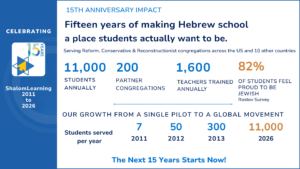
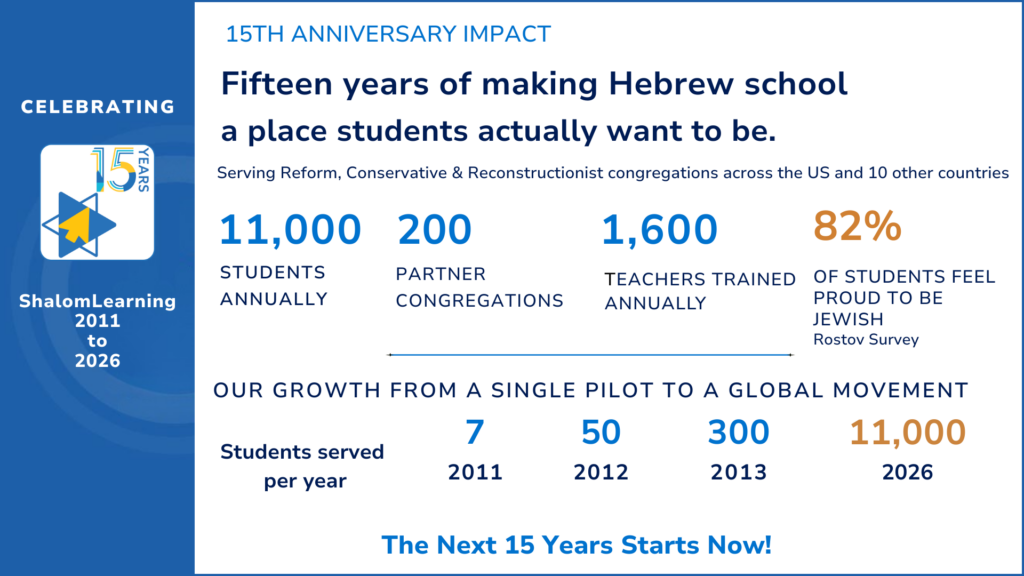
In 2011, the pilot launched at Congregation Beth El with seven students. Not seven hundred. Seven.
The idea: stop teaching Hebrew school the way it had always been taught — children in rows, textbooks open, facts to memorize — and start teaching the way today’s kids actually learn. Blend the classroom with technology. Lead with Jewish values, not just Jewish history. Make it engaging enough that a kid who just got home from school and “just wants to chill out” might actually choose to log on.
One of those early students, 11-year-old Nathan Slotnick of Bethesda, put it plainly. With traditional Hebrew school, he said, “you’d have to go on a weekday right after you get home from school, when you just want to chill out, relax, and do whatever you want.” ShalomLearning’s flexibility changed that. He appreciated being able to do his lessons “over the weekend” — and the YouTube videos and interactive tools helped the material stick. “You can see what the setting is, what happens, how big the characters are, how they react,” he said.
By year two, three synagogues and 50 students were enrolled. By year three, nearly 20 synagogues and 300 students. A curriculum covered seven core Jewish values —Accountability for our Actions, Teshuvah, Inner Strength, Gevurah, Responsibility, Achrayut, A Peaceful World, Shalom, and more — each one woven through with contemporary examples designed to connect ancient wisdom to a kid’s actual life.
Samara Katz, an education director in the Boston area, captured the moment perfectly: “I feel these kids go to school in the 21st century, and then they come to religious school and it’s about 1950.”
ShalomLearning set out to change that.
Reaching the Families No One Was Reaching
Among the most meaningful chapters in ShalomLearning’s story is one that rarely makes the highlight reel: military families.
Crystal Codner, a U.S. Army veteran in Arizona, had to drive two and a half hours to reach the nearest synagogue. There was no Hebrew school nearby. Then she learned about ShalomLearning through an Army chaplain. “ShalomLearning is ideal, because the kids can get onto it wherever we are,” she said. “As military families, we’re always in a transient state, so to have something that can always go with you — especially when you don’t know where you will be in a year — to have a consistent curriculum — that’s important to me.”
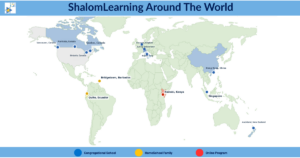
The Levy family, then stationed in Naples, Italy, put it this way: “ShalomLearning has been a fabulous asset in our quest to keep our son’s and daughter’s Jewish identity intact in a non-Jewish environment and to strengthen their understanding of Jewish values and history.”
Thanks to an anonymous donor who underwrote tuition for military families, the program was offered at close to no cost. Hebrew school, delivered to families halfway around the world. This was not the original plan. It became something better.
What Families Said Then
Numbers can tell you how many students enrolled. They can’t tell you what it meant.
Todd Klein, a parent from the early days: “My son loves to use the computer, so ShalomLearning has engaged Jake beyond my highest hopes. He looks forward to every session and he actually asks to work on his language lessons! I am excited that Jake’s younger brothers have this great option.”
A rabbi at Temple Israel in West Bloomfield, Michigan: “I think anything we can do to meet students where they are is definitely the wave of the future.” Her students, who had been using so much technology in their daily lives, were finally getting the equivalent of a second hour in the classroom — and liking it.
Susan Pinsky Bleeks, principal at B’nai Israel Religious School in Southbury, Connecticut, the first synagogue in the state to use ShalomLearning, had watched attendance improve dramatically on Tuesday afternoons — previously the school’s hardest session to fill. “These same children who would miss a lot of Tuesdays are there most of the time now,” she said.
Fifteen Years Later And Still Becoming
Fifteen years in, ShalomLearning is not the same organization that launched with seven students in a suburban Bethesda synagogue. It is bigger, broader, and more necessary than ever serving 11,000 students in partnership with 200 synagogues and religious schools spanning Reform, Conservative, Reconstructionist, and independent communities.
In a moment when Jewish communities face real challenges — antisemitism, disengagement, the fragmentation of communal life — the work of giving young Jews a reason to stay connected has never mattered more.
We remain committed to what we’ve always believed: that Jewish education can be something children genuinely look forward to. That our oldest values have something powerful to say to every new generation — in the language they live in, in the world they’re growing up in. Jewish families everywhere deserve learning that meets their children with energy, meaning, and joy.
Thank you for being part of this story. The next fifteen years start now.