Leading the Conversation: ShalomLearning Defines the Future of AI in Jewish Education
This past month, the Jewish educational landscape reached a turning point regarding Artificial Intelligence (AI), and ShalomLearning was at the heart of the movement.
We were proud to serve as a lead sponsor and featured presenter at two of the field’s most influential gatherings: the ARJE (Association of Reform Jewish Educators) Annual Gathering and the Jewish Digital Summit (presented by 70 Faces Media). Our presence at these events underscored our commitment to being not just users of technology but leaders who define its ethical and pedagogical boundaries.
Deep-Diving into the “Anxious Middle” at ARJE
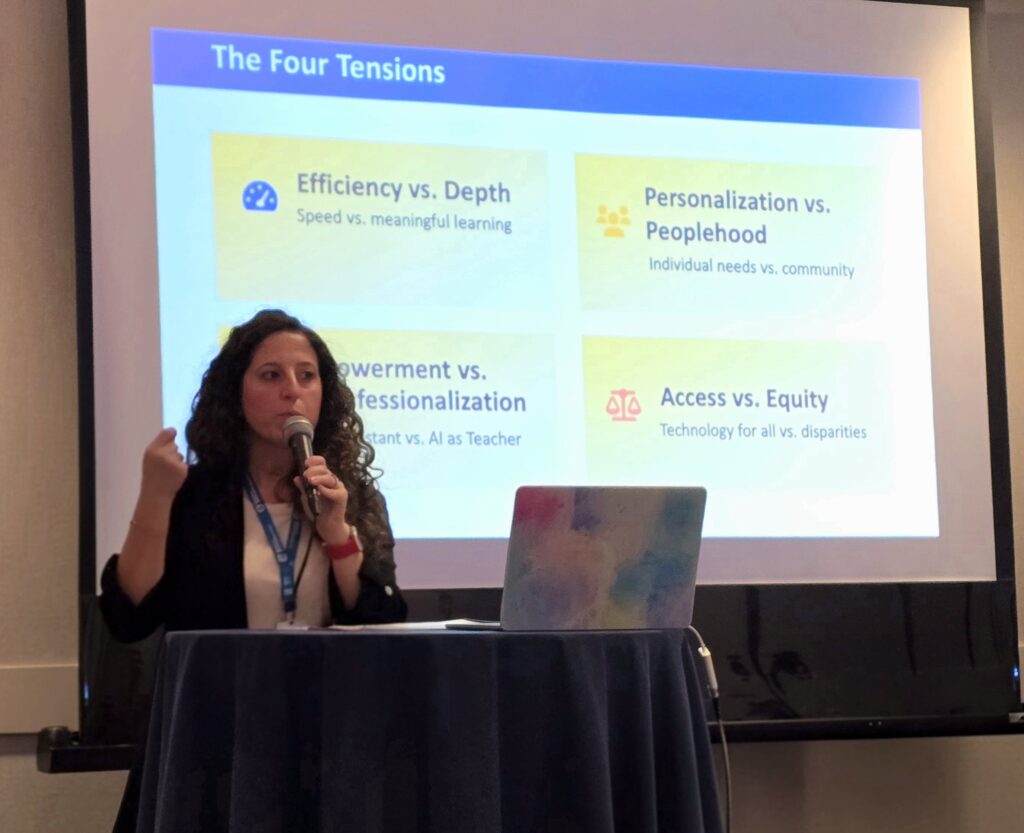
At the ARJE conference, Heidi Lovitz (Senior Managing Director) and Shira Sender (Director of Client Care and Teacher Support) led a high-impact, three-hour “Deep Dive” session for more than 80 Jewish education professionals.
Entering the room, many expected to find a sharp divide between those who embrace AI and those who fear it. Instead, we discovered a vast “Anxious Middle.” We met educators who are curious and eager to experiment but feel they are currently “winging it” without institutional policy or a moral compass. At ShalomLearning, we believe no teacher should be left to navigate these waters in isolation.
A Voice Among Leaders at the Jewish Digital Summit
The conversation continued at the Jewish Digital Summit, where Heidi Lovitz joined a featured panel alongside Rivkah Schlack of the Jewish Education Project and Sara Wolkenfeld, Chief Learning Officer of Sefaria, serving as moderator.
The chemistry among these leaders was powerful. There was a resounding consensus: we must not let technology dictate our direction. Instead, it is up to us as a community to harness these tools to support the sacred work of teaching and learning, ensuring that technology serves the human relationship, not the other way around.
From “The Automated Pilot” to “The Curator of Meaning”
During these sessions, we moved away from technical jargon to focus on a universal choice every institution faces:
- The Automated Pilot: This is the risk of treating AI as an all-knowing oracle—a “black box” that gives us answers while we passively watch. When we do this, we lose our agency and the human nuance of our tradition.
- The Curator of Meaning: At ShalomLearning, we advocate using AI as a tool that organizes collective human output, but it requires a human expert to provide context, warmth, and purpose.
In this new era, the educator’s role is more vital than ever. While a bot might provide a student with facts, only a teacher can serve as the Curator of Meaning, the one who helps a student understand how that information connects to their life, community, and values.
Building the Roadmap Together
One of the clearest takeaways from these conferences is the urgent need for institutional support. Educators are currently working out, for themselves and for their students, how to use AI responsibly.
ShalomLearning has been at the intersection of Jewish values and technology for over a decade. We are not just participants in this new frontier; we are the architects helping build the guardrails. We’ve been in the trenches with educators and educational leaders, and we are now distilling the ethical frameworks and practical policies discussed at these events into a roadmap for the community.
If your institution is exploring how to develop an AI policy for your education department or beyond, we would be honored to consult with you. Reach out to Heidi Lovitz or Shira Sender to learn more about how we can help your team move from anxiety to agency.