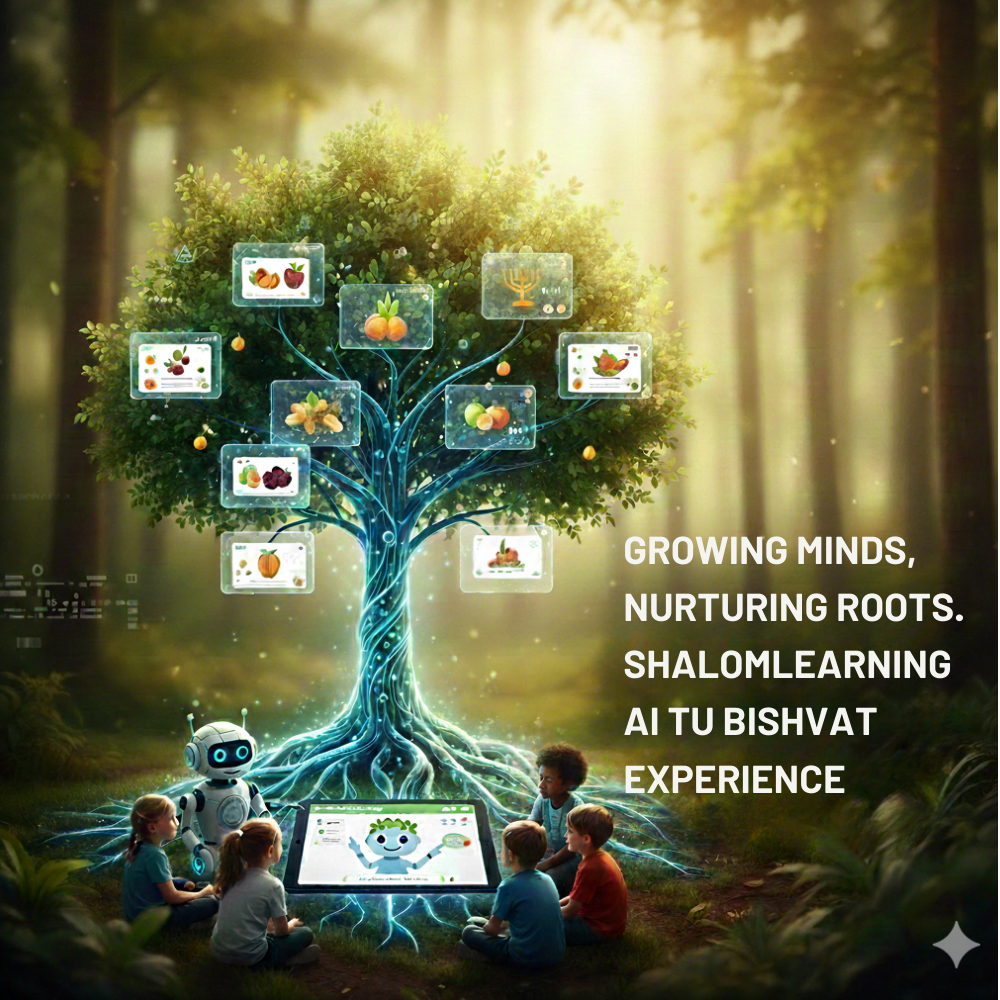
Tu BiShvat invites us to celebrate trees, the land, and our relationship to the natural world. This year, we’re pairing that tradition with one of ShalomLearning’s core Jewish values: responsibility (Achrayut, אַחֲרָיוּת).
In this new learning experience for grades 5–6, students explore what responsibility really demands, especially when doing the right thing comes with a cost: time, money, comfort, popularity, or even risk. That question matters deeply for pre-teens, who are eager to challenge assumptions, test limits, and understand where they fit in something larger than themselves.
Why We’re Excited About This AI-Enhanced Lesson and What Makes It Different
We’re using Brisk Teaching not for “technology’s sake,” but because it supports what great educators aim for: active participation, deeper reasoning, and meaningful reflection especially in the limited time we often have.
This isn’t a “read and discuss” worksheet. It’s a structured, interactive learning experience that combines Jewish values, Israel, and real decision-making:
- Student prereading introduces responsibility (Achrayut), environmental stewardship as a mitzvah, and wasteful destruction (bal tashchit, בַּל תַשְׁחִית).
- Students step into an “Israel Land Council” role and wrestle with a realistic dilemma about land care and shared resources.
- In AI-guided Debate Mode, students stay engaged and focused as they support claims with evidence-based reasoning, consider multiple perspectives and tradeoffs, and revise/refine their thinking as new information is introduced—just like real learning requires.
- The experience closes with an exit ticket and a measurable “values in action” pledge.
It also supports teachers by making it easier to run a high-quality debate experience within limited class time, and it includes accessibility features many classrooms appreciate—such as read-aloud and voice-to-text.
Why We’re Using AI—and Why This Lesson Still Stays Human
It’s fair to ask: Should students be engaging with bots? Our answer is: only when it strengthens human learning. That’s exactly how this lesson is designed. The AI isn’t replacing the teacher, discussion, or relationship-based Jewish learning—it functions as a structured “practice partner” so students can think more deeply before they bring their ideas into peer conversation and teacher-led meaning-making.
What the AI adds (especially in limited class time):
- Every student participates: not just the few who usually dominate a debate. Students must respond, revise, and reflect.
- Stronger thinking before sharing: the AI helps students sharpen ideas, name tradeoffs, and build language—so class discussion is richer, not repetitive.
- Values stay at the center: prompts keep returning students to responsibility (Achrayut), stewardship as a mitzvah, and fairness when needs conflict.
And the lesson intentionally includes high-touch, human moments throughout—because Jewish learning is built on relationships: teacher-led framing about the “cost of responsibility,” partner/small-group talk before the debate, quick “turn and talk” choice points, teacher coaching during the activity (“Who is the ‘other’?” “What tradeoff are you accepting?”), a whole-class debrief, and a meaningful close with an exit ticket and measurable action pledge (which can become a shared class commitment).
Bottom line: the AI supports the practice; the teacher and peers create the meaning.
What Educators Are Saying
We invited experienced elementary educators to review the lesson before release, and their feedback confirmed what we hoped: this experience feels both usable and exciting.
Maryn Simon (5th grade educator, DC area) shared:
“A great way to introduce the topics, and I’m sure students will enjoy working with AI.”
Erica Veronie (5th Grade Dual Teacher, Woodland Intermediate) praised the clarity:
“Layout is easy to follow and use, and the lesson plan is clear.”
She also appreciated the transparency around the tool:
“I really like that you gave the rationale for Brisk as well as its safety ratings.”
And she highlighted the learning value of the guided back-and-forth:
“There is a lot of back and forth with the ‘Brisk AI partner,’ which is great to really simulate the problem and have students think through all aspects.”
She also loved the built-in accessibility:
“I loved that it could be read aloud and I could use my microphone to record my answer instead of typing… a great way to differentiate.”
Dara Hoyt emphasized teacher usability:
“Really thorough and nicely laid out… A great sheet to give to teachers to use to teach the lesson.”
Ready to Try It?
If you’re looking for a Tu BiShvat experience that feels timely, relevant, and genuinely engaging for today’s learners while still grounded in teacher facilitation and peer conversation we’d love for you to try it.
Download the Tu BiShvat AI Learning Experience (Teacher Guide + Student Materials):
Click Here
As always, we’d love to hear how it goes in your learning community, what your students debated, what surprised them, and what actions they pledged afterward.